
If you’re trying to figure out how to start homeschooling and feel overwhelmed by options, expectations, and opinions—you’re not alone.
Most parents don’t struggle because they aren’t capable.
They struggle because they’re trying to hold too much at once:
- What curriculum should I choose?
- How do I know what to teach?
- What about grade levels and standards?
- How do I teach multiple children?
- What if I mess this up?
So instead of beginning, they stay stuck in research mode.
Let’s simplify this.
You don’t need to figure out everything.
You need a clear place to begin—and the freedom to start simply.
What Actually Matters When You Start Homeschooling
Before we talk about schedules or curriculum, we need to ground this in something steady:
Homeschooling is not about replicating school at home.
It’s about building a life of learning within your family.
That means:
- You don’t need a full system on day one
- You don’t need to “cover everything” immediately
- You don’t need to match what public school would be doing
You are building something different—something more connected, more flexible, and more meaningful for your kids, for you, and for your family as a whole.
Step 1: Understand the Transition (Deschooling)

If your child has been in school—or if your expectations are shaped by school—there is a transition period that matters more than most people realize.
This is often called deschooling.
Deschooling is not “doing nothing.”
It’s intentionally stepping away from:
- Constant evaluation
- Rigid schedules
- External pressure
…and allowing space to:
- Rebuild curiosity
- Reset rhythms
- Reconnect as a family
What this can look like:
- Reading aloud together daily
- Spending time outside
- Letting your child explore interests
- Slowing down academics temporarily
- Experiencing the world as a family
For some families, this lasts a few weeks. For others, longer.
And that’s okay.
You may hear the suggestion to deschool for one month per year your child was in school. But in practice, it’s less about a fixed timeline and more about a shift in thinking.
What you’re looking for is a change in how both you and your child understand learning.
Two Practical Recommendations for Deschooling
First: Create limits around screens
I’m not a screen hater. We enjoy TV, and my kids play video games. But when you’re trying to build a culture of learning—especially with less structured days—screens can easily take over.
In our home, unless we’re in a full rest week, we don’t allow screens before 3pm.
By delaying access to easy entertainment, children have time to:
- experience boredom
- explore
- reach for more meaningful activities
And by setting a clear boundary, you remove decision fatigue.
If it’s not 3pm, the answer is simply no.
Second: Try backward planning
A powerful exercise during this time is to write down what your children actually do each day.
- Did they draw?
- Play outside?
- Build with Legos?
- Read?
- Play with siblings?
- Dig a tunnel in the backyard? (We still have one!)
- Help cook a meal?
- Go for a walk or bike ride?
Write it down as learning.
This is called backward planning, and it helps you begin to see learning differently.
When you stop feeling like learning only happens at a desk—with a test and a deadline—you know you’re moving in the right direction.
Step 2: Choose a Simple Structure (Not a Full System)
This is where many families get stuck.
They think:
“I need to choose the perfect curriculum and full-year plan before we start.”
You don’t.
Instead, start with a simple, repeatable structure for your day.
Not a rigid schedule. Not a fully built system.
A clear flow.
A Simple Starting Point
When you’re beginning, think in three parts:
First: Begin Together (Morning Basket / Prompt Beginnings)
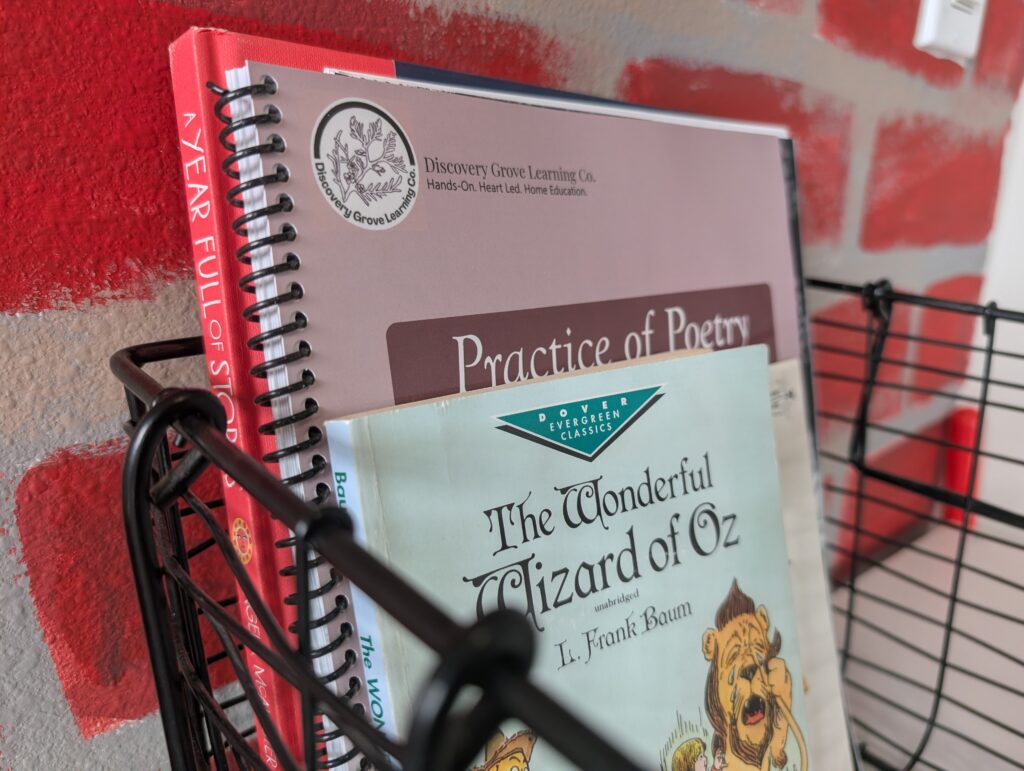
Start your day by gathering together.
This is not about checking off subjects—it’s about beginning well.
This might include:
- Poetry
- Scripture
- Calendar or seasonal awareness
- A short read-aloud
This time sets the tone for your day.
It creates:
- A shared starting point
- A calm transition into learning
- A habit of beginning promptly
You are not trying to do everything here.
You are beginning with what matters and what comes simply.
Then: Learn Together (Family-Style Study)
After your morning gathering, move into shared learning.
This is where you teach subjects like:
- History
- Science
- Literature
Together, as a family.
This is the anchor of your homeschool.
It allows you to:
- Teach multiple ages at once
- Build shared knowledge and conversation
- Go deeper, rather than spreading thin
Next: Build Skills (Independent & Guided Work)
From there, shift into foundational skill work.
This is where children begin working more independently, with your guidance as needed.
This might include:
- Math
- Reading or phonics
- Piano or another instrument
With younger children, this will still be more hands-on.
With older children, this becomes increasingly independent.
Why This Structure Works
This flow allows you to:
- Start your day with intention (first)
- Learn together deeply (then)
- Build independence over time (next)
It keeps your homeschool:
- Grounded
- Manageable
- Sustainable
It’s not about a timetable or always doing everything.
It’s about shaping the flow of your day in a way that fits your family and provides natural progression.
Start Here
If you’d like help mapping this into your actual day,
download the Bare Roots Homeschool Planner.
It’s a simple starting tool designed to help you:
- explore your family’s rhythm
- try light, flexible planning
- practice backward planning
- step away from the traditional school model
Step 3: Focus on What Matters in the Early Years
One of the easiest ways to become overwhelmed in homeschooling is by trying to do too much, too soon.
But both Charlotte Mason and Thomas Jefferson Education point us in a different direction—especially in the early years (0-9ish years).
Early education is not about covering everything.
It’s about building strong foundations while cultivating a love of learning.
What Actually Matters First
In the elementary years, your focus is twofold:
Foundational Skills
- Learning to read well
- Learning to communicate clearly (through speaking, narration, and early writing)
- Building a steady foundation in math
A Rich Learning Environment
- Exposure to meaningful ideas through books and conversation
- Time for play, exploration, and imagination
- Strong relationships within the family
These are not separate priorities—they work together.
A More Aligned Approach: Learn Through Living Ideas
Charlotte Mason emphasized living books and meaningful ideas.
TJEd emphasizes early learning rooted in:
- Curiosity
- Relationships
- A love of learning
Both point toward the same shift:
Children learn best when they are engaged in meaningful ideas—not fragmented information.
Anchor Your Learning Around Shared Literature
Rather than separating every subject, you can anchor much of your homeschool around:
Literature + shared learning
This looks like:
- Reading rich stories together
- Discussing what you read
- Allowing ideas to connect naturally
This approach:
- Brings multiple ages together
- Encourages deeper understanding
- Builds strong language skills naturally
And it simplifies your day.
How This Grows Over Time
In the early years, learning doesn’t begin with heavy instruction.
It begins with exposure and interest.
Children:
- Hear rich language through stories
- Notice patterns in numbers
- Ask questions and make connections
At first, this is light:
- Listening
- Exploring
- Engaging with ideas
But over time, something shifts.
As interest grows, so does readiness.
From Exposure → Practice
This is where more formal learning begins to take shape.
Not all at once.
Not through demanding lessons.
But gradually, through:
- Short reading practice
- Simple writing and narration
- Consistent, focused math lessons
Practice grows out of interest—not pressure.
What This Means for You
You are not choosing between:
- “Let them play”
or - “Start school”
You are guiding a progression.
From:
- Curiosity → capability
- Exposure → skill
- Interest → discipline
A Gentle Next Step
If you’re unsure how to move from exposure into skill-building in a way that feels meaningful and leaves room for varying levels of readiness, this is exactly the space Art of Language was designed to support—helping children grow from listening and speaking into reading, writing, and clear expression through rich, shared literature.
Step 4: Set Realistic Expectations (This Changes Everything)
When you understand how learning develops over time, your expectations begin to shift.
You no longer feel pressure to:
- Do everything at once
- Push long academic days
- Constantly move ahead
Because you can see the progression.
What Most Parents Don’t Realize
Early elementary students typically need:
1–2 hours of focused learning per day
Not 5–6 hours like a traditional school.
Where the Rest of Learning Happens
The rest of their growth comes through:
- Play
- Conversation
- Exploration
- Real-life participation
What This Means
You are not behind.
You are not doing too little.
You are simply doing something different.
Step 5: Start Small—and Actually Begin
This is the most important step.
Not planning.
Not researching.
Beginning.
Your First Week Can Be Simple
- Read aloud daily
- Do a short math lesson or even a board game
- Practice reading or phonics
- Draw or create
- Spend time outside
- End the day peacefully
That’s it.
What You Don’t Need Right Now
You don’t need:
- A full-year plan
- Every subject scheduled
- A Pinterest-worthy homeschool room
Those things can come later—if they even need to.
What You Are Building Instead
You are building:
- A family culture of learning
- A rhythm that supports your real life
- A space where your children can grow
This takes time.
And it starts simply.
If You Want a Clear Place to Begin
If you’re still feeling unsure how to put this into practice:
- Start with a simple plan → Bare Roots Planner (free)
- Add structure through shared learning → Art of Language
- Build your rhythm gradually
You don’t need to do everything.
You need to begin with what matters—and let it grow.
Final Thought
A Charlotte Mason principle says:
“Begin with what is necessary, then what is simple, and you will find you are doing the impossible.”
Start small.
Start simply.
And most importantly—
Start.